


2025 Ford Explorer vs Toyota Highlander: Road Trip SUV Comparison
- Explorer brings a bolder redesign and roomier third row; Highlander keeps a classic look with tighter third-row space.
- Tech edge: Explorer’s Ford Digital Experience (13.2" screen) and available BlueCruise vs. Highlander’s simpler setup.
- Both rate well for safety; Explorer earned IIHS Top Safety Pick+ and both achieved 5-star NHTSA overall ratings.
2025 Ford Explorer vs Toyota Highlander: Road Trip SUV Comparison
When families in Georgia need a three-row SUV, the Ford Explorer and the Toyota Highlander always come up. Both have solid reputations for comfort and capability, making them popular choices for everything from school runs around Warner Robins to cross-country adventures and road trips through Macon and the rest of central Georgia.
For 2025, however, both SUVs have undergone some changes. The Explorer now boasts a fresh design and some serious tech upgrades, while the Highlander prioritizes practical features for everyday convenience. So, which new SUV is the better choice for your next road trip or family outing? Let's break it down in this 2025 Ford Explorer vs. Toyota Highlander comparison.
Design and Exterior Styling Comparison
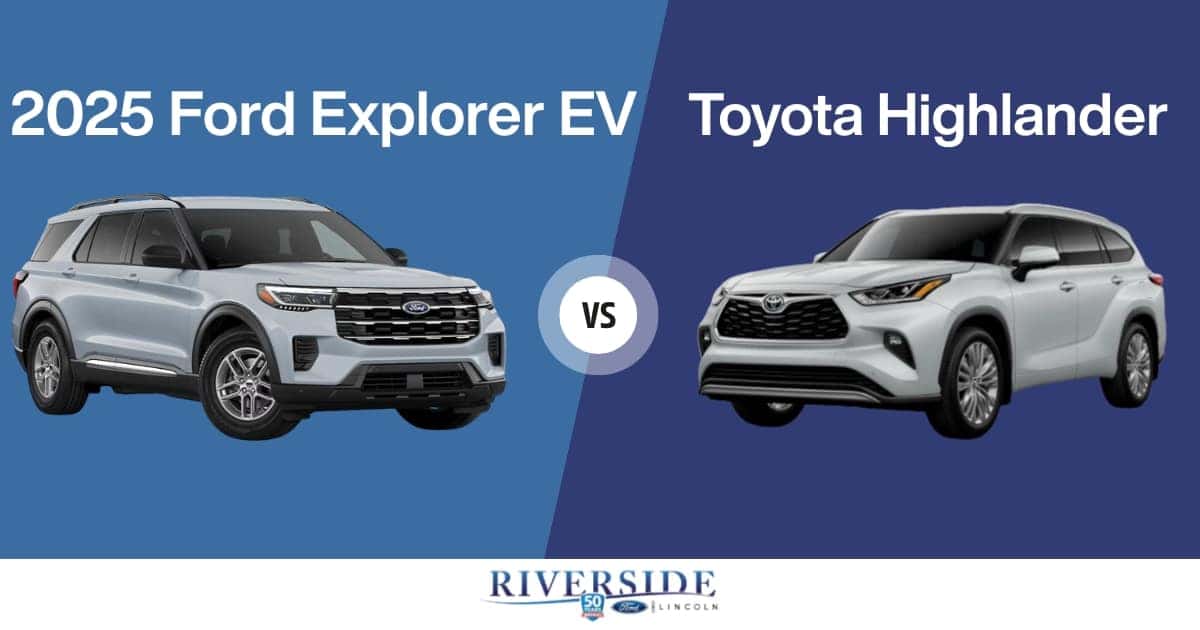
The 2025 Explorer shows up with a completely new face. You get new all-LED headlights, four different grille styles depending on your trim, and redesigned taillights. You can also add a black roof on Platinum, ST, and ST-Line models for a two-tone effect. New wheel designs come in 18, 20, and 21-inch sizes, plus a striking Vapor Blue Metallic paint option. The overall vibe is athletic and modern.
In contrast, the Highlander's design remains largely unchanged for 2025. You'll get some new color options like Heavy Metal and Cement on select trims, but that's about it. While the Highlander's timeless style may appeal to some, others might prefer the Explorer's bolder, more modern look.
Interior Space, Cargo, and Comfort for Long Journeys
This is where the Explorer really pulls ahead. It has more passenger space than the Highlander, which you can feel on long drives down I-75. The biggest difference is in the third row. The Explorer offers 32.2 inches of legroom compared to the Highlander's tight 28 inches. That extra four inches means adults and teenagers can actually sit comfortably in the back.
The 2025 Explorer also gets an upgraded cabin with new soft-touch materials on the console, doors, and dashboard. Second-row passengers get 39 inches of legroom compared to the Highlander's 38.7 inches. Even better, a simple one-touch button mechanism makes it easy to slide the second row forward for access to the back.
Cargo space is also better in the Explorer. You get 18.2 cubic feet behind the third row and 87.8 cubic feet total. The Highlander offers 16.0 and 84.3 cubic feet, which is still spacious but not as roomy as the Explorer. Whether you're hauling sports gear for Macon youth leagues or loading up for a trip to Lake Tobesofkee, those few extra feet in the Explorer will come in handy.
Infotainment and Connectivity
Ford went all-in on tech for 2025. The Explorer gets a new Ford Digital Experience system with a 13.2-inch touchscreen and a 12.3-inch digital gauge cluster. It works with Google and Amazon Alexa for voice commands, navigation, and apps. You can even stream shows or play games when parked. Eight USB ports come standard, and you can upgrade to a 12-speaker Bang & Olufsen sound system.
Toyota's Highlander doesn't quite keep up on tech. Base models have a small 8.0-inch screen, while higher trims get a 12.3-inch display. Neither matches the Explorer's massive screen or advanced software. You do get wireless Apple CarPlay and Android Auto, a Wi-Fi hotspot, and an optional 11-speaker JBL system. While functional, it feels dated compared to the Explorer's bigger, more integrated setup. For families prioritizing in-car tech, the Explorer offers a distinct advantage.
Performance and Engine Options
The Explorer offers much more power than the Highlander. Its standard engine is a turbocharged 2.3-liter four-cylinder that makes 300 horsepower. It gets the Explorer to 60 mph in a quick 6.0 seconds. For even more power, you can get a twin-turbo 3.0-liter V-6 with 400 horsepower. This engine, standard on the ST trim, is genuinely fast, hitting 60 mph in just 5.1 seconds.
The Highlander has only one engine option: a 2.4-liter four-cylinder with 265 horsepower. It feels sluggish in comparison, taking 7.2 seconds to reach 60 mph. It's fine for daily driving, but it feels sluggish when merging onto Highway 247 or passing traffic. The Explorer also uses a modern 10-speed automatic transmission that provides smoother shifts than the Highlander's eight-speed.
Both SUVs can tow up to 5,000 pounds, so they are equally capable of pulling a boat to Lake Sinclair. However, the Explorer's extra power and rear-wheel drive make towing feel more effortless, especially when going up steep hills.
Fuel Economy and Efficiency
Fuel efficiency is where the Highlander gains some ground. With front-wheel drive, it gets an EPA-estimated 22 mpg in the city and 29 mpg on the highway. The Explorer's standard four-cylinder engine gets 21 mpg in the city and 28 mpg on the highway. If you choose the Explorer's powerful V-6, fuel economy drops to 18 mpg in the city and 26 mpg on the highway. For most drivers around Macon and Warner Robins, the small difference in gas mileage might not be enough to overlook the Explorer's significant performance benefits.
Safety Ratings and Reliability
Both vehicles have strong safety ratings. The 2024 Explorer earned a Top Safety Pick+ from the IIHS and a five-star overall rating from NHTSA. The 2025 Highlander also got five stars from NHTSA and good ratings in most IIHS tests.
Standard safety tech is solid on both. The Explorer boasts Ford's Co-Pilot360 Assist+, which includes features like automatic emergency braking and adaptive cruise control. For 2025, the Explorer adds available BlueCruise hands-free driving on certain trims. The Highlander has Toyota Safety Sense 2.5+, which offers similar safety aids but doesn't have a hands-free driving option.
J.D. Power gives the Explorer a reliability score of 87 out of 100, which is rated "Great." The Highlander scores an 81, also rated "Great." The Highlander does have a stronger projected resale value after five years.
Visit Riverside Ford to Test-Drive the Explorer
The best way to spot the difference between the 2025 Ford Explorer and Toyota Highlander is to test-drive both. We invite you to visit Riverside Ford in Warner Robins to experience the Explorer firsthand. Our team can help you check out trim options and explore payment plans that fit your needs. Call us to schedule a test drive at Riverside Ford today and see why the Explorer is the smarter choice for Georgia families.
Frequently Asked Questions
Is the 2025 Ford Explorer roomier than the Toyota Highlander?
Yes. Explorer offers 32.2 inches of third-row legroom versus the Highlander’s 28 inches, plus up to 87.8 cu ft of cargo space compared to 84.3 cu ft in the Highlander.
Which SUV has better in-car tech for road trips?
Explorer adds the Ford Digital Experience with a 13.2" touchscreen, 12.3" digital cluster, and available Bang & Olufsen audio—along with available BlueCruise hands-free driving on certain trims.
How do fuel economy and performance compare?
Highlander’s 2.4L turbo-4 is more efficient (up to 22/29 mpg FWD), while Explorer’s engines deliver stronger acceleration (300 hp standard; available 400 hp V-6). Many buyers find the Explorer’s power worth the small mpg trade-off.
0 comment(s) so far on 2025 Ford Explorer vs Toyota Highlander: Road Trip SUV Comparison