


Ford Explorer EV vs Hyundai IONIQ 5: Which Electric SUV Fits Your Life?
- Explorer EV (EU model) targets ~319 miles of range with DC fast-charge 10–80% in ~26–28 minutes; IONIQ 5 can charge 10–80% in ~20 minutes.
- Space check: Explorer seats five with versatile cabin storage; IONIQ 5 offers 26 cu ft cargo with a flat floor and reclining front footrests.
- US availability for Explorer EV is pending; test Ford EVs now (F-150 Lightning, Mustang Mach-E) at Riverside Ford in Macon, GA.
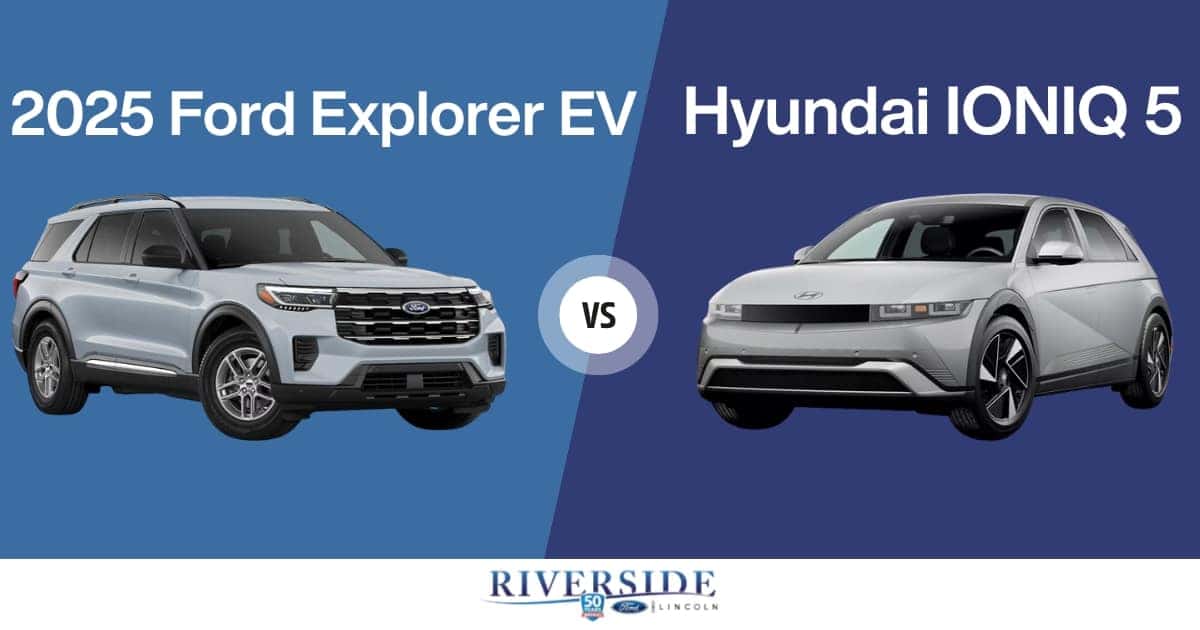
Ford Explorer EV vs Hyundai IONIQ 5: Which Electric SUV Fits Your Life?
The Ford Explorer EV is currently a Europe release, but word of this electric SUV is making waves across in Macon, GA. The Hyundai IONIQ 5 is already available here, but the Ford Explorer EV may be worth the wait. For now, check our online inventory or schedule a test drive to explore our current Ford EV oprtions while keeping updated on the Explorer EV. Here's what you can expect.
Introduction: Availability and who these EVs fit
The Ford Explorer EV is equipped with a lithium-ion NMC battery with an estimated range of 319 miles. With RWD, it has a usable capacity of 77 kWh, while the AWD version can manage 79 kWh. With a DC fast charger, you can take your battery from 10 to 80% in just 28 minutes with RWD and 26 minutes with AWD. The DC max charging power is 135 kW with RWD and 185 kW with AWD. Both options get AC max charging power of 11 kW.
The Hyundai IONIQ 5 comes standard with a 63-kWh battery pack that has a 245-mile range. Select models feature an 84 kWh battery with an estimated range of 318 miles. Despite these impressive estimates, a real-world test by Car and Driver yielded only 210 miles on a single charge.
It goes from 10 to 80% in 20 minutes with a fast charger. The IONIQ's day-to-day capabilities are less impressive. You'll need to plan on plugging your IONIQ in overnight with AC home charging. Under regular conditions, it can go from 10 to 100% in 7 hours and 20 minutes.
It's important to understand how far you can get when you're operating an EV. Planning I-75 runs from Macon, Georgia? Ask Riverside Ford about road-trip charging tips and nearby public chargers before your EV test drive.
Space, Seating & Everyday Usability
The Ford Explorer seats five passengers across two rows, with 16.6 cubic feet of storage in the back. The trunk offers hands-free accessibility, so you can always get what you need when you need it. The Explorer features convenient cabin storage that includes a private locker and spacious central console so you can stash purses, bags, and even laptops easily. This makes the Explorer an ideal pick for daily commutes around downtown Macon or day trips to Lake Sinclair.
The Explorer includes a host of creature comforts like heated front seats, a heated steering wheel, and a massaging driver's seat. Dual climate controls let the driver and passenger set their temperatures independently. This will help you stay comfortable if you're making a longer trip from Macon and branching out along the Southern Pacific Route.
The IONIQ also seats five across two rows. It offers 26 cubic feet of cargo space for a little extra luggage room. The floor is completely flat to maximize storage space. The front seats even include reclining footrests if you want to rest while the vehicle is charging. While this is a creative inclusion, it may not be necessary if you install a convenient home charging port or have easy access to one of the 66 public charging stations in Macon.
Performance, Ride & Driver Assistance
Both the Explorer and IONIQ offer a choice of AWD or RWD, so you can customize your vehicle to get the specs you need. The AWD Explorer EV produces 282 horsepower and 402 lb-ft of torque, jumping from zero to 60 in about 6.4 seconds. The IONIQ, in comparison, produces between 168 and 320 horsepower and 446 lb-ft of torque. It can jump from zero to 60 in 4.5 seconds.
The Ford Explorer comes equipped with a 15-inch adjustable screen for a flexible digital experience. The screen offers easy app integration and advanced driver assistance features. In Europe, the Ford Explorer is rolling out with Assisted Lane Change and Clear Exit Assist. This can make it easier to navigate tricky Macon interstates like I-75 and I-16, where it can be hard to navigate lane changes.
The IONIQ features a head-up display with augmented reality to complement the 12-inch touchscreen and 12-inch digital gauge cluster. While the IONIQ works with Apple CarPlay and Android Auto, it's not wireless. Standard driver assistance technology is available. including automated emergency braking with pedestrian detection, lane-departure warning, and lane-keeping assist. Adaptive cruise control with lane centering is available.
Price, Warranty & Ownership
This is where the comparison gets tricky. The Ford Explorer EV isn't available in the US yet, so expected pricing is still unknown. However, we can expect it to come with Ford's standard EV warranty package, which includes a 3-year/36,000-mile basic vehicle warranty, a 5-year/60,000-mile powertrain warranty, and an 8-year/100,000-mile battery coverage.
The IONIQ comes with Hyundai's warranty package that includes a 5-year/60,000-mile limited warranty, a 10-year/100,000-mile powertrain warranty, and 10-year/100,000-mile battery coverage.
The early ownership costs are slightly lower for your average Ford than for a Hyundai. You can expect a 1- to 5-year cost of around $1,100, while a Hyundai runs about $1,130 over the same period. EVs are especially affordable because they don't require the same maintenance and care as gas-powered vehicles.
Accessing the Ford Explorer EV
The release of the Ford Explorer EV in the United States is highly anticipated. If you weren't excited yet, the enticing details above should get you there. While we don't know exactly when this much-awaited electric vehicle will cross the pond, we can promise that Riverside Ford will keep a keen eye out for its arrival. If you're itching to try a Ford EV now, come take the F-150 Lightning or Mustang Mach-E for a spin. We're excited for you to discover the power and capability behind Ford's electric offerings.
Frequently Asked Questions
Is the Ford Explorer EV available in the United States?
Not yet. The Explorer EV highlighted here is a European release; Riverside Ford will update availability for Macon, GA shoppers as Ford announces US plans.
How fast do these EVs charge from 10–80%?
Explorer EV: about 26–28 minutes (AWD/RWD); IONIQ 5: about 20 minutes on a compatible DC fast charger. Home AC charging is best for overnight top-ups.
Which has more cargo space?
IONIQ 5 lists about 26 cu ft behind the second row and a flat floor. Explorer EV emphasizes creative storage like a private locker and a large center console.
0 comment(s) so far on Ford Explorer EV vs Hyundai IONIQ 5: Which Electric SUV Fits Your Life?