


What Tire Psi Is Recommended on the Ford F-150?
Your tires are your truck’s only contact with the road, so it’s crucial to take care of them for your vehicle’s and passengers’ safety. One of the most basic but essential maintenance tasks is regularly checking your tire pressure.
Underinflated or overinflated tires can affect your truck’s handling and cause the tires to wear unevenly or prematurely. It will also reduce your truck’s fuel economy. Using the recommended tire pressures helps extend the life of your tires and saves you money.
PSI for the Ford F-150 Tires
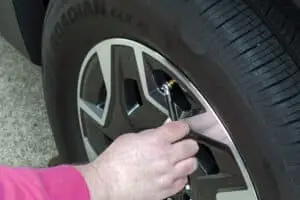
The recommended tire pressure for the Ford F-150 can vary according to the size and type of the wheels and tires and the model year. The F-150 is available with 17-inch, 18-inch, 20-inch, or 22-inch wheels, depending on the trim level. Since the 2015 model year, the recommended F-150 tire pressure has been 35 to 40 psi.
For everyday driving in most models, Ford recommends a tire pressure of 35 psi for the front and rear tires. If your truck comes with the Heavy-Duty Payload Package, you should increase the pressure to 40 psi on the front and rear. The recommended tire pressure for the high-performance off-road specialized F-150 Raptor is 38 psi for front and rear tires.
If you intend to tow a trailer, you might need to adjust the tire pressure on your truck, and the front and rear pressure may differ. Remember to check the trailer’s tire pressure too. The factory-trained technicians at our Riverside Ford service center will gladly advise you if you have any doubts about tire pressures when towing.
How To Determine PSI
You can find details of your truck’s recommended tire pressure and other important information in your owner’s manual and on a label affixed to the edge of the driver’s door or the B-pillar. If you look at your tires’ sidewalls, you’ll see a tire pressure listed, but that rating is the maximum inflation pressure permitted for that tire. You should only use the vehicle manufacturer’s recommended psi.
How To Maintain Your Tires’ PSI
If you own a recent F-150 model, you’ll have a tire pressure monitoring system (TPMS) that measures the pressure of all four wheels. This TPMS allows you to check your tire pressure from the comfort of your vehicle via the Sync 3 or Sync 4 infotainment system. To access the tire pressure information, use the instrument cluster screen arrows to go to the truck information section, then navigate to the tire pressure tab. You can view the tire pressure for all four wheels there.
Even if your truck has a TPMS, it will only warn you if there’s significant air loss in one or more tires. In all cases, Ford recommends manually checking your tire pressure at least once a month and always before a long road trip. The tires typically lose around 1 psi every month. If the TPMS warning light comes on, you need to check the pressure as soon as possible.
You can use a small portable air pump at home or a tire air compressor at a gas station to check the psi. Simply unscrew the valve cap, push the pressure gauge outlet onto the valve stem, and the gauge dial will show you the tire pressure. If the psi is too low, top it up, and if it’s overinflated, let some air out. You should always try to check and adjust the tire pressure when the tires are cold.
If You Need To Check the Pressure of Hot Tires
As you drive, your truck’s tires get hot due to the friction caused by the road. Driving for just three minutes or more than a mile can increase tire pressure by around 4 psi. If you need to adjust the pressure when the tires are hot, add 4 psi more to the recommended tire pressure. Later, when the tires are cold, you should recheck the pressure and adjust it if necessary.
TPMS Malfunction
If the TPMS of your truck malfunctions, it may fail to detect or alert you of low tire pressure. The warning light will flash and remain on. There are various reasons why the system might malfunction, such as tire rotation, tire replacement, or fitting tires of different sizes. You’ll need to reset the system to fix the issue.
Resetting the TPMS
To reset the TPMS, you’ll need to drive to a location where you can easily reach all four wheels and access an air compressor. Follow these steps:
- Drive your truck at over 20 mph for at least two minutes and park in your chosen location.
- Switch off the ignition, then switch it back on without starting the engine.
- Switch the hazard warning lights on and off three times.
- Let air out of the front left tire until the horn sounds. Then, do the same with the front right, rear right, and rear left tires.
- Switch off the ignition.
- Fill all the tires to the recommended tire pressure.
When you start the truck, the TPMS should work correctly and show the right tire pressures on the display. If you have problems resetting the system or the reset procedure doesn’t work, bring your truck to our tire center so our technicians can do it for you.
Why Is the Correct Tire Pressure Important?
Ensuring your tires are correctly inflated is crucial for optimal vehicle performance and safety. Proper tire pressure helps in several key areas:
- Fuel Efficiency: Underinflated tires create more rolling resistance, which causes your engine to work harder and consume more fuel. Conversely, maintaining the recommended tire pressure can improve your vehicle’s fuel economy.
- Tire Longevity: Tires that are not inflated to the correct pressure wear out unevenly, reducing their lifespan. Underinflated tires typically show wear on the edges, while overinflated tires wear more in the center. Both conditions can lead to premature tire replacement.
- Safety: Underinflated tires are more prone to overheating, which can cause tire failure, especially during long drives or in hot weather. Overinflated tires, while potentially improving fuel economy, reduce traction, particularly on wet roads, and increase the risk of a blowout due to the reduced contact area with the road.
- Handling and Performance: Correctly inflated tires ensure optimal contact with the road, providing better handling, stability, and braking performance. Overinflated or underinflated tires can negatively impact your vehicle’s handling, making it more difficult to control, especially in adverse conditions.
Maintaining the recommended tire pressure for your vehicle not only enhances its performance and efficiency but also plays a vital role in ensuring your safety on the road. Always refer to your vehicle’s owner manual or the tire information placard for the correct tire pressure and check it regularly to avoid potential issues.
Need Help or Advice About Tires?
If you have any questions or concerns about your F-150 tire pressure, bring your truck to our dealership in Macon, Georgia. We can handle all your tire needs, including mounting, rotation, balancing, alignment, and replacement.
Ensure that your tires have proper pressure by Oregon Department of Transportation is licensed with CC BY 2.0
0 comment(s) so far on What Tire Psi Is Recommended on the Ford F-150?